Sep 13, 2006

Life


I almost gave up to write today. I'm having problems with Blogger and everytime I try to login the browser window simply closes. I had to do a lot of gymnastics to be able to get here today!

Well, to be honest, I didn't know exactly what to write until I started to read the science news. Then, I stumbled with this one:

Why viral stowaways are a baby’s best friend

This news talks about something called endogenous retroviruses (ERV). They are remnants of virus DNA which attached to our DNA in some point of our evolution and remains there even today. I remember that sometime ago I read about the fact that ERVs are responsible for the growth of the placenta, which is the main subject of the above news.

Probably, there are a lot of other ERVs in our DNA which somehow gave us some advantage and remain there executing important functions. This added to the fact that bacteria play a major role in our digestion and that our energy comes from processes taking place in the mitochondria, which are a kind of alien organism which lives in symbiotic relationship with us, even with his own DNA different from ours, implies that we are not only one organism, as we feel to be. We, indeed, seem to be a colony much alike an ant conlony, but where the components are not allowed to take a walk outside and then come back.

Thinking about that, it is amazing how complex a life form can be. Another amazing news somehow related which I read recently, and unfortunately lost the link :( , was about a kind of cancer which affect dogs and is contagious. I was amazed when a read the origin of this disease: it is not a bacteria or a virus, it is a group of tumorous cells from an ancient dog or wolf which can be passed from animal to animal and replicate themselves inside it. In a way, the animal which was the original owner of the cells is around and will be around probably forever in the form of cloned cells carried by host animals! Now, is it an organism or not?

Seeing how creative and unimaginably complex Nature can be with respect to life, I can only smile when I see aliens in sci-fi movies with almost the same form as us. I bet that when we finally make contact with other technological species from another planet it will be something that we have never imagined before.

Picture: Mouse osteoblast, from the University of Western Ontario website.

Sep 6, 2006

Paris


Last week I didn't write anything in Skepsisfera, but I have a good excuse: I was in Paris. I spent three days there. Wonderful place. I went to the Notre Dame, Sacre Coeur, Eiffel Tower, Arc de Triomphe, Versailles Palace and the Louvre Museum. Versailles and Louvre are specially incredible. I spent one whole day inside each of them. The sky was clear and the weather was hot. And since I left Brazil I hadn't such a good coffee. Unfortunately it's over. I took a lot of pictures, but as my pen drive is dead and my MP3 player doesn't work with linux I am not able to put them here. Maybe next week...

Well, as I was out, I have not too much things to say today. I forgot to put here the paper related to the aledged proof of existence of dark matter. it is in the arXiv:

A direct empirical proof of the existence of dark matter
Douglas Clowe, Marusa Bradac, Anthony H. Gonzalez, Maxim Markevitch, Scott W. Randall, Christine Jones, Dennis Zaritsky
astro-ph/0608407

And yes, as everybody knows, Pluto was downgraded. Never mind, for there are a lot of astronomers complaining ablout that. To be honest, I don't see any problem. If Pluto is considered a planet, Xena should have the same write as well as other similar celestial bodies around the sun. Pluto not even orbites the sun in the same plane as the other planets. Science is a matter of objectivity, if Pluto does not fit along with the other planets, it is natural to create a new category.

Before I come back to my work, just a little interesting article I found in Wikibooks:

Arimaa


It is a game where computers cannot beat us yet...

Picture: The Louvre Museum. I took this picture from this site: http://www.unf.edu/.

Aug 23, 2006

Busy Week


Well, a lot of things happened this week. First of all, you don't need to look for Grigory Perelman anymore. Yes, he was found, he won the Fields Medal and, as expected, he declined it. The guy is tough. Anyway, he had his reasons (at least he said that). Read the detailed news here: Maths genius declines top prize.

There is also a very important news. NASA researchers are saying that they proved that dark matter exists beyond doubt by indirect observations. They crossed data from three different sources (three telescopes) and measured the gravity in a huge collision. Dark matter was proposed as a kind of matter that only interacts by gravity (no electromagnetism, no weak force, no strong force...) to explain why galaxies have the observed structure although we cannot see the matter which should be there to explain that. There are alternative theories though, but the researchers say that the main explanation has to be dark matter according to the measurements. In short, what they saw was an event where electromagnetism separated the ordinary matter from dark matter, allowing guys to measure it. The complete story is here: Cosmic smash-up provides proof of dark matter.

This week, although I knew its existence for a long time, I tried to explore Wikibooks, a project related to Wikipedia where people share knowledge in the form of free books. There is an incredible variety and they are extremely interesting. I recommend it strongly!

Another interesting news is an article about the bombing plot here in the UK. Everybody heard about that. The police discovered a plot to detonate liquid explosives in planes going to the USA. It seems like an action movie and, if this article make sense, it really is: Mass murder in the skies: was the plot feasible?. I am not a chemist to know if the article is correct. If there is one reading this, please give your opinion.

And for those researchers interested in helping the human space colonization, the Mars Society is looking for volunteers for an experiment: Four-Month Mars Mission Simulation at the Flashline Mars Arctic Research Station: Hard Work, No Pay, Eternal Glory. I would be a volunteer, if I was not married...

To finish this random collection of paragraphs today, the guys of the 'Delta de Dirac' rock band contacted me. I heard their music and its the kind of rock that I really like. Their site (finally I know) is www.deltadedirac.com. You can download a demo of their music there. They told me that their guitar player studied electronic engineering, that's the reason of the name. And their logo is amazingly cool too! :)

Picture: Busy Life, by Edwin Gardner.

Aug 16, 2006

Wanted: The Russian who smashed Poincare


Jules Henri Poincaré was a French mathematician AND physicist AND philosopher who made a lot of important (and beautiful) contributions to all those branches of science. In some sense though, his most famous contribution was an (until now) unproved conjecture which has his name: the Poincare Conjecture. As you can read in the Wikipedia link, the modern version of the conjecture seems very simple:

Every simply connected closed (i.e. compact and without boundary) 3-manifold is homeomorphic to a 3-sphere.

I'll explain it in a moment. First, let me say that it is a conjecture because Poincare asserted it without proving. He was led to think that it could be true by clues in his work, but was unable to prove it in that time. The second thing is that it is so important to mathematics (and probably to physics too) that it is one of the famous Millenium Prize Problems from the Clay Institute, which include among others, the P=NP problem, the solution of Navier-Stokes equation and the Riemann Hypothesis. It means that whoever solves one of them is entitled to receive the US$ 1,000,000.00 prize!

Poincare conjeture talks about topology. A 3-manifold is a mathematical set that looks like a 3-dimensional euclidean space if you look very close (what is called locally in technical language), like the Earth looks like a flat locally, but is really a sphere. The 3-sphere is just the familiar sphere in 3-dimensions, i.e., the whole sphere, including its interior. In mathematics, when you say that two things are homeomorphic, you are saying that, in practice, they are the same. Now, the notion of being simply connected. A set is simply connected if any closed curve (e.g., a circle) in the set can be continuously shrinked to a point without breaking. The classical example is the sphere against the torus (i.e., the doughnut). Inside a sphere, you can shrink any closed curve to a point without breaking, in a torus, if the curve goes around the hole, you cannot shrink it to a point, you are stopped by the hole. The term compact is a little technical and in some sense means that the set is not infinite. The non-boundary condition means that you cannot found the boundary of the set. The circle, seen as a one-dimensional object, has no boundaries. Indeed, it is a one-dimensional manifold which is compact, has no boundary but fails to be simply connected. Actually, you can say that it is a 1-dimensional torus.

As you can see, although it is simply stated, it has a lot of technical subtleties and stood without proof until the russian mathematician Grigory Perelman posted some papers in the arXiv saying that he had found a proof. The problem is that the papers where very compact and took some time to be dissecated. And now, that it seems that they were and the proof seems correct, Dr. Perelman simply disappeared! You can read the detailed story in the NY Times: Elusive Proof, Elusive Prover: A New Mathematical Mystery.

The detailed version of the Poincare Conjecture is in the Clay Mathematics site, as well as the papers explaining his proof. I'm linking them here just in case:

- Ricci Flow and the Poincare Conjecture, John W. Morgan, Gang Tian (math.DG/0607607)

- Notes on Perelman's papers, Bruce Kleiner, John Lott (math.DG/0605667)

- A Complete Proof of the Poincaré and Geometrization Conjectures - application of the Hamilton-Perelman theory of the Ricci flow, Huai-Dong Cao, Xi-Ping Zhu

If you find Dr. Perelman, please send an email to the CLay Institute! All mathematicians in the world want to find them. It is very probable, as it is what he likes most to do, that he is looking for mushrooms in some Russian forest.

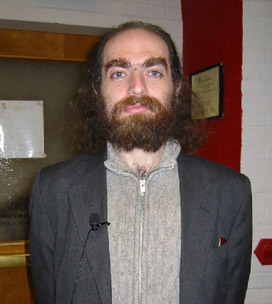
Picture: The Guy.

Aug 11, 2006

Aug 9, 2006

The Dirac Delta


I've been doing replica calculations since I arrived in UK. Appart from the replica trick itself, these calculations involve a lot of interesting and useful mathematical tricks and techniques. One of them, which I particularly like, is related to the Dirac delta function.

The Dirac delta is not a function in the correct sense of the word, it is a distribution and is a very odd object. It is defined rigorously as a limit of functions. There are different functions that gives the Dirac delta in some limit, but (in my opinion) the most elegant is the Gaussian distribution. It goes like this:


The main characteristics of the delta is that its integral over the entire real line is one and it has the filtering property:


The legend (as I couldn't find more accurate historical details) says that Dirac introduced the delta to study point charge distributions in electromagnetism. Soon, a lot of other applications were found for it. I stumbled with one in the replica papers. It is usual in replica calculations to do the following transformation:


Let me explain. In the above equation, s is a random vector with probability distribution P(s) and x a constant vector. What I'm doing is a change of variables under the integral. Now, the new one-dimensional (and this is important!) variable v is a random variable and its distribution will be


The average of the delta over s. If you look more closely, there is a very interesting thing ocurring here: if you consider the equations above without the probability distributions like


The integral of the delta is nothing more than the Jacobian of the transformation. The interesting is that it is a Jacobian of a transformation between variables with different dimensionality. I'll leave to the reader the pleasure to see that all the Jacobian properties and delta function properties match beautifully indeed. I also bet that this can be related with Gauss theorem (or the generalized Stokes Theorem) although I haven't done the detailed calculations.

Now, changing the topic a little, I found this nice site about Singular Value Decomposition, a kind of matrix decomposition which is important in numerical calculation, but not only there. I remember that once I entered the office of (again) Prof. Caticha and he was playing with SVD. He transformed a picture in a matrix, calculated the singular values and took the resulting matrix as the original ignorating the less important singular values. The result was an image almost equal to the original one: a kind of compression technique.

Picture: I also discovered that 'Delta de Dirac' is the name of a Mexican band of progressive rock and the picture is of one of its CDs. Unfortunately, I didn't find their website. If someone knows, please tell me.

Aug 4, 2006

Links & News


A friend sent me an interesting site today with lots of physics flash applications. They range from chaos maps to a little calculation of a Stern-Gerlach experiment.

I also found two very interesting news which I am listing below. The third one concerns the question Hawking posted on Yahoo Answers!: How can the human race survive the next hundred years? Full Hawking's own answer is here.

Okay, here are the news:
  1. Scientist thinks invisibility possible in future
  2. House and Garden: Architects design a living home
  3. The great man's answer to the question of human survival: Er, I don't know

Picture: from the story House and Garden above.

Aug 2, 2006

Cubes 2


I know, this sequence of titles looks like that terrible movies Cube and Cube 2: Hypercube (I apologize to those who liked them...), but Prof. Caticha answered my email and, as I predicted, there is a more elegant formula for expressing the n-cubes algebraically. It is not to much different from the one I posted, but I will describe it anyway. Instead of initiating with the representation of the 1-cube as I showed in the last post, you can initiate it by representing the 1-cube as the Pauli matrix


Also, changing the notation of the unity matrices such that I_n is the (n+1)x(n+1) unity matrix just to make the final formula prettier and following exactly the same procedure as before, the expression for the n-cube becomes


Well, I have nothing specific to speak this week, but I was browsing the arXiv and found some odd papers. What I mean is that they have curious titles, but I really still haven't read them to say something about their contents. I'm listing them here if someone wants to check. :)
  1. Football: a naive approximation to the effect of increasing goal size on the number of goals - J. Mira (physics/0607183)
  2. A fixed point in Coptic Chronology: the solar eclipse of 10 March, 601 - John Ray, Gerry Gilmore (astro-ph/0607520)
I have found some interesting links this week:
  1. California and Carnegie Planet Search
  2. Wave Packets Animations
  3. Find a Postdoc
and also some news:
  1. Mysterious quasar casts doubt on black holes
  2. Shadowy T-rays: Hunting Tumors and Exploring the Universe
  3. Medical 'Miracles' Not Supported by Evidence

Picture: Hypercube, by Shem Booth-Spain

Jul 26, 2006

Cubes


[Last edition: 28/07/2006]

As I promised two weeks ago, I'll talk about cubes today. One of the things Prof. Caticha taught me in his visit is an interesting way of representing cubes in any dimension using matrices. First, let me explain what is a n-dimensional cube, or simply a n-cube. Let us use an iterative method to construct it. Let us set up our notation: the representation of the n-cube will be denoted by the letter


The 0-dimensional cube is just a point and we will represent it by a 1x1 matrix, or as it is more commonly known, by a number: the number 1. We will consider n-cubes as being non-directed graphs and represent them by their connectivity (or incidence) matrix: the (i,j) element of the matrix will be 1 if the i-th vertex of the graph is connected with the j-th vertex and 0 otherwise. This justifies using the number 1 to represent the 0-cube, once it has just 1 point which we will consider as connected to itself.

Now, let us proceed two the 1-cube. The one-dimensional cube is just a line segment joining two points. We will see it as two 0-cubes joined by their vertices and then it will be represented by the 2x2 matrix:


In the end, a n-cube can be described by a block matrix derived from the (n-1)-cube with the form


Where I_{n-1} (in LaTeX notation :) ) is the (n-1) x (n-1) identity matrix and its role is to connect the vertices of the two C_{n-1} cubes to form its edges. An algebraic way to write this is


Where, if A is a 2x2 matrix, then


is the exterior, tensor or Kroenecker product between the two matrices A and B, which gives as a result a block matrix as indicated, and


is a Pauli matrix. Actually, I think there is a slightly more beautiful formula, but I forgot now and I'm waiting for Prof. Caticha to answer me an email I sent him...

Okay, now that I did what I promised, some more random things.

Latest (and some old) interesting news:
  1. Scientists Say They’ve Found a Code Beyond Genetics in DNA
  2. Look Around You - A Visual Exploration of Complex Networks
  3. U.S. Miltary Plans Shape-Shifting Supersonic Bomber
  4. 10 cutting-edge network research projects you should know about
On my desk:
  1. "The Bethe lattice spin glass revisited", Marc Mezard, Giorgio Parisi (cond-mat/0009418)
  2. "Against 'Realism'" - Travis Norsen (quant-ph/0607057)
Picture: A projection in 3 dimensions of a 12-cube taken from the site Equality Set Projection - A new algorithm for the projection of polytopes in halfspace representation

Jul 20, 2006

Blogging...


I should have blogged yesterday, but I needed to check a formula which I wish to put here, which I will do in the next week (I hope). I will just talking here today about some random things.

First, today is the 37th anniversary of the first visit of men to another celestial body. Of course I'm talking about the moon, as we didn't manage to visit (at least personally) any other, which I hope to happen still in my lifespan. Indeed, i would like to do it one day (I know, I'm dreaming too much...). You can have more details in the Wikipedia article: Apollo 11.

Another thing is that I found an interesting paper in the arXiv yesterday:

Physical limits on information processing
Stephen D. H. Hsu
hep-th/0607082

It is about bounds on the velocity of information processes in nature. This article is one of many I've been following in the last years which shows a trend to study information as a physical quantity. I'd like to call it Information Physics, or maybe, to be a little more modern, iPhysics.

Anyway, I sent an email to Stephen asking about the definition of information process. He was kind enough to answer me very fast and I will reproduce it here as it may be interesting:

Hi Roberto,

I'm using the Margolus-Levitin (ML) definition, which is evolution
from some initial state i to some orthogonal final state f (e.g.,
| f > = 0 ).That is defined as a single operation.

In classical computation this seems quite reasonable, as "flipping a
bit" presumably means moving some part of the system from, e.g., one
energy eigenstate to another, which would mean a transition between
two orthogonal states.

For quantum computation it is not so clear how to define a discrete
unit of computation. However, I think what ML chose is very
reasonable. If you haven't evolved the system into a different
orthogonal state, it isn't really distinguishable from the initial
state as it still has some overlap with the initial state.

Hope that makes sense.

Cheers,
Steve


Stephen also pointed me to his blog "Information Processing", which is very interesting and I'm adding to my list in the lateral column.

Picture: Astronaut Buzz Aldrin on the moon, from NASA.

Jul 12, 2006

Visitor


Professor Nestor Caticha, my former PhD advisor in Brazil, has been visiting Aston University for three weeks and departed in the last Saturday to attend to the MaxEnt 2006 conference in Paris, in which he will present two papers, one of them in collaboration with me: Online Learning in Discrete Hidden Markov Models

We had a good time and, as always, we talked about several different and interesting matters, among them, geometricalgebra, integration and hypercubes. I will not talk here about geometric algebra, once that I have already written a post about that in the past (see Geometric Algebra). I'll talk about integration and let hypercubes to the next week.

You may think 'What could be interesting in integration?'. Well, we didn't talk about ordinary integration, of course. What we did talk about was something that, for a lack of a better term, I will call 'fractional integration'. Consider the function:


D is just a constant. For t going to zero, the gaussian becomes a Dirac delta function and the integration simply gives the function f(x). For t going to infinity, the square root outside the integral cancels the numerator inside it and the exponential becomes 1, giving the ordinary integral of f. So, as the parameter t varies from 0 to infinity, we vary from the ordinary function to the totally integrated function in a continuous way. He said to me that it has applications in renormalization group theory and, consequently, in QFT. He aso told me that his brother, Ariel Caticha, used this kind of integral in his PhD thesis to expand the action in path integrals in QCD. I need to play a little more with this, but seems a very interesting idea that could have more applications.

Well, changing the subject, I was browsing the Wikipedia and found this interesting Raven Paradox with a Bayesian solution. Probably Osame already know it, but It could be interesting for his students. :)

(As you may note, my posts are becoming smaller with time. I apologise, but the quantity of work here in Aston is increasing and my available time does not scale with it. So, I'll keep things this way for a while. Sorry again.)

Picture: Prof. Nestor Caticha in his office at the University of Sao Paulo, Brazil.

Jul 5, 2006

Branes, Descartes and Reality


When I was young I tought that science was concerned with the ultimate nature of reality. It was a long road before I realized that reality is a complicated concept that inhabits the realm of philosophy. Sometime ago, when I was reading about braneworlds, I thought about a situation that can illustrate it quite well.

Imagine that the universe contains two branes that, by hypothesis, do not interact in any way. Each brane has a set of physical laws that enables the development of intelligent life. Let us say that we humans live in one of these branes. As there is no interaction (and will never be) with beings in the other brane, their existence is something that science is not concerned with. Indeed, as the hypothesis of their existence is not falsifiable, it is ruled out as science by its the very definition. Of course our science cannot deny our existence, but as the situation of both branes is symmetric, for the scientists of the other brane talking about our existence is also unscientific. If you take by heart Descartes' Cogito ergo sum, then both civilizations exist but only for themselves, the existence of one to the other is not a scientific hypothesis in each brane. And it is not just about the civilizations, but the non-interaction effect rules out the entire brane from the scientific realm of the other.

A friend with whom I talked about this told me that it is similar to the traditional paradox of the tree falling without nobody to watch, but the brane paradox above is more deep, because the tree can in principle leave traces of its fall, but the branes cannot sense the existence of each other by hypothesis!

Well, that is why I started to study a little philosophy in addition to physics. Although it may be not falsifiable, the nature of reality is an interesting question and I remember that, when I was a child, curiosity was the true feeling that led me to choose to be a scientist.

By the way, today is another Holy Day for physics, maybe even holiest than the day of my last post. In this day, in 1687,
Philosophiae Naturalis Principia Mathematica (which appeared in the Da Vinci Code depicted as a book about astronomy and gravity :) ) was first published by Isaac Newton. We can say in a certain way that, for physics, this was the book (an the man) that really started it all in the way we know it today.

Picture: http://www.nevis.columbia.edu/~conrad/visuals/hep_images.html

Jun 30, 2006

Holy Friday


A very brief post today, only to celebrate the date. Today is a sacred day for physics: 101 years ago, in 1905, Einstein published his paper "On the Electrodynamics of Moving Bodies" (the original work is "Zur Elektrodynamik bewegter Körper", Annalen der Physik. 17:891-921, June 30, 1905).

It was the starting of Special Relativity and the beginning of a revolution in physics. You can find more about it in Wikipedia's "Annus Mirabilis Papers".

Have a nice day! :)

Jun 22, 2006

If I were a rat...


Douglas Adams in his enlightening series Hitchhiker's Guide to the Galaxy tought us that humans are only the third most intelligence lifeforms on Earth, dolphins are the second and in the top of the rank stand... the rats. He also tought us that these tiny little animals are just tridimensional protrusions of pandimensional superintelligent creatures from which our dear Earth is just a complex experiment. In summary, we don't experiment with rats, they experiment with us.

Don't you believe? Take a look on these news

Cancer destroyed by antibody 'triple whammy'
Clearing protein 'smokescreen' helps battle cancer
Diabetes gene therapy carried by 'bubbles' in the blood
Stem Cells Help Repair Rats' Paralysis
Alzheimer's vaccine shows success in mice
Engineered virus thwarts ovarian cancer in mice

As you may see, without making any efforts, just relying on our "voluntary" work, rats are immune to cancer, can be cured of diabetes, Alzheimer and even paralysis! Okay, sometimes there are very bizarre experiences like the one they made with the poor rodent in the above picture, but the payoffs are high. In the course of getting from us the question for the Answer to The Ultimate Question Of Life, the Universe and Everything (which, by the way, is 42), they're getting smarter, longlived and healthier (much more than us). And of course here are a lot of and making movements to forbid cruel experiments with mice. How they manipulate us!

And I couldn't even find most of the headlines I have already read about them! Although human medicine does not have the cure for a lot of conditions, rat medicine can cure almost everything! And even when these cures filter to our humble human community, rats got them years ahead of us.

Now, serious. Although sometimes there are options to experiments with animals, specially with mice, sometimes there aren't. We humans don't know biology enough to simply run computer simulations to test treatments to diseases, reactions to drugs and new kinds of surgeries. If experiments with animals can lead to the cure of cancers or Parkinson, the only thing we can do is to minimize suffering of the animals, but these are matters of life and death and, unfortunately, if I had to choose between my mother and 100 rats, I'd rather be with her. Sorry but it is the truth.

Picture: er... do not remember... if someone knows where this comes from I would be grateful.

Jun 14, 2006

Jerusalem 2006


I came back from the Evergrow Workshop in Jerusalem this Saturday at about 13:00. It was a very instructive workshop where we learned how to use the resources of Everlab, a cluster of computers scattered along universities mostly in Europe and with the central administration in the School of Computer Science and Engineering of the University of Jerusalem (HUJI).

The notorious participants were physicists Nicolas Sourlas, the first one to point out the link between Statistical Physics and Error-correcting codes (see cond-mat/9811406 for a short overview), and Scott Kirkpatrick, the pioneer of replicas and spin-glasses (you can find a good introduction with all the relevant papers, include the one from Kirkpatrick, within the book Spin Glass Theory and Beyond), by Mezard, Parisi and Virasoro). Kirkpatrick is the project manager working at HUJI. The organization of the workshop was due to Danny Bickson and Elliot Jaffe, two local researchers responsible for the Everlab and the Condor implementation at it, another resource that can be used by the Evergrow project to run programs in different computers. The importatnt feature of Everlab and Condor is that anyone in a computer inside a member institution of the project can use the resources of comuters in any member cluster, such that me, here in Aston, can use the computers at Rome (which is not a good example as they are always running at their limit) to run my programs if they are free.

Apart from this, we also have presentations of the members describing how they use or plan to use these resources. An also interesting presentation was of the people from the DIMES project. This project aims to create a map of the internet and relies on distributed computation in the same sense as in the SETI@home project, to do so. If you are interested in helping these guys, what I recommend a lot, you can download the freeware that will consume very little resource from your computer and you will have access to some of their data.

About the city, Jerusalem is a very sunny city, without a single cloud in the sky in all the five days I stayed there. It seems a very secure place with respect to crime, I didn't see any trouble and really felt safe even at night. The strange thing although is that wherever you go in the city you will find young people of about 18 years with rifles and machine guns. They told me later that it's because every young in Israel needs to serve the army and they are responsible for their guns even when they are not at the base, so they have to carry then everywhere in order to avoid that they end up in the wrong hands.

I visited the old city, the impressive walled old Jerusalem where there is the Church of the Holy Sepulcre, the alledged place where Jesus is buried, and where is the famous Wailing Wall. The markets inside the city makes you feel like you're in an arab movie. I took photos, but I cannot put them here because I didn't manage to put them on my computer yet.. :o

I also visited the Museum of Israel, the home of the Dead Sea Scrolls. They're well accomodated in a building named the Shrine of the Book. The Museum also has a beautiful collection of old artifacts that date back thousands of years. I just had one day to see everything, but it would take more than it to fully aprecciate all the collection.

The campus of the University of Israel has a curious name for me. It's called Edmond Safra and it brought memories of the time when I worked in Brazil for Edmond's brother Joseph Safra in the Safra Bank. A rich family as you can imagine.

In the end, the only bad part of the travel is when you leave the country. In the Ben-Gurion Airport, the only international airport of Israel, you have to pass a very strict security check where the guy asked me to show him the photos I took, to explain him how was the workshop, to describe all the places I visited and even to explain to him what physics has to do with Internet. Well I thought in sayint to him to look at my blog to see the answer to this last question, but it would be a long journey back to UK and I didn't want to spend a lot more time answering security questions.

Picture: sight of the wall of the Old City of Jerusalem, by Danny Bickson

---
Edited: 21-June-2006